
When Did You Become So Hard on Yourself? Thoughts From a Beautician

I often wonder what would happen if women spoke to their friends the way they speak to themselves. Would we tell our best friend she looked old because she had a few lines around her eyes? Would we point out every blemish or grey hair, or draw her attention to every part of her body that had changed over the years? Of course we wouldn't. We'd probably be horrified if we heard somebody else speaking to her that way, and yet somehow we've become very comfortable saying those things to ourselves.
Every week, I have the privilege of meeting so many different women at Meraki Beauty. Different ages, careers and stages of life, all coming through the door for different reasons, and yet there's something I hear surprisingly often. Before they've even sat down, women start apologising for themselves. "Please ignore my skin." "My brows are awful." "I look so tired today." Sometimes it's even, "Sorry, I'm a complete mess."
I wish I could let them see themselves through my eyes for five minutes, because the things they're apologising for are very rarely the things I notice. I see their smile, their eyes, the way their whole face changes when they laugh. I notice warmth, character and all the little things that make somebody look unmistakably like themselves. None of that disappears because their skin has decided to have a bad week or because they've developed a few more lines around their eyes.

Why Are We So Critical of the Way We Look?
Something that has really struck me over the years is that this isn't something that suddenly begins when we get older. Some of the women I meet in their twenties and early thirties can be incredibly critical of themselves too. They'll point out tiny lines, pores, asymmetries or imperfections that I genuinely wouldn't have noticed if they hadn't shown me where to look.
I don't think it helps that we're surrounded by more images of faces than any generation before us, and so many of those faces have been filtered, edited, carefully lit or photographed from exactly the right angle. When that's what we're looking at every day, it's easy to forget what real people actually look like. Skin has texture, faces aren't perfectly symmetrical, we get tired and our appearance changes as we move through life. None of those things mean we've somehow let ourselves go.
If I had a penny for every negative thought a woman had about her appearance, I genuinely think we'd all be millionaires by now.
Learning to Speak to Myself Differently
Earlier this year, I started therapy myself, and during one session my therapist asked me a question that really stopped me in my tracks: "If you were your own best friend, what would you say to yourself?"
It sounds like such a simple question, but I realised that I had absolutely no trouble offering kindness, patience and understanding to the people around me. If somebody I loved was struggling, I wouldn't expect perfection from them. I'd understand why they were finding things difficult, reassure them and probably remind them of all the things they were doing brilliantly. When it came to myself, though, that inner voice could sound completely different. It was much harsher and far less forgiving.
It made me realise how easily we accept humanity in everyone else while expecting something completely different from ourselves. Since then, I've been trying to catch myself when I do it. I certainly don't manage it every time and I'm very much still learning, but I've started asking myself whether I'd say the same thing to somebody I loved. If the answer is no, I'm trying to question why I think it's acceptable to say it to myself.

When Did Looking After Yourself Become Something to Feel Guilty About?
There's something else I've noticed through years of working with women: so many of us stop choosing ourselves after having a family. It isn't usually a conscious decision and it's not because we don't want to look after ourselves. Life just gradually gets in the way.
Children need us, partners need us, parents get older and work gets busier. There's always a house that needs cleaning, a washing basket that somehow fills itself back up and another little job that feels more urgent than doing something for ourselves. Without really deciding to, we slowly move ourselves further and further down the list.
Looking after ourselves becomes something we'll get around to one day, when everything else is sorted. The trouble is, everything else is never really sorted. Then, when we finally do take an hour for ourselves, we somehow manage to feel guilty about that too, as though looking after ourselves means we're giving something less to everybody else.
I really don't believe that's true, and I don't think self care has to mean a huge wellness routine, an expensive retreat or reinventing your entire life either. It might be an uninterrupted walk, reading a book, having a coffee by yourself or simply having an hour where nobody is asking anything of you. And yes, sometimes it might mean having your brows done because you've wanted them done for the last six months, or finally booking the facial you keep putting off.
Those things aren't important because they transform you into somebody new. Sometimes they're important simply because you've chosen to do something for yourself.
My Work Isn't About Making Women Look Younger
Because I work in skin, aesthetics and semi-permanent makeup, I think people sometimes assume my job is ultimately about helping women look younger. It really isn't, and I'm certainly not interested in convincing women that ageing is a problem we need to fix.
What I really love is helping somebody feel like herself again. Sometimes that means finally getting on top of a skin concern that has affected her confidence for years. Sometimes it's restoring brows that have gradually become sparse, or using semi-permanent makeup to give somebody back a little of the definition she's lost over time. Sometimes a client simply wants her skin to feel healthier and fresher. And sometimes it's nothing more complicated than giving somebody an hour on a treatment bed where, for once, nobody needs anything from her.
Of course the treatment matters, but I've always felt that what happens around it matters too. Being listened to properly, having somebody understand what you actually want rather than telling you what you should change, and being looked after for a little while can be just as valuable.
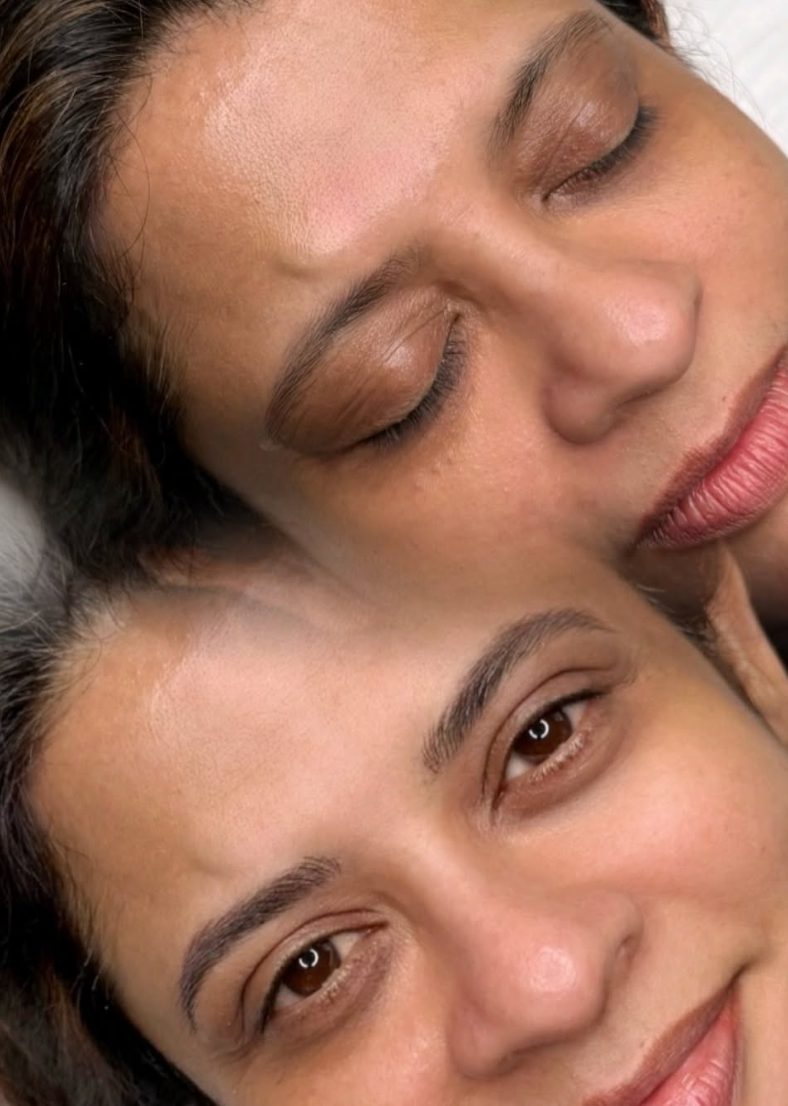
You Don't Have to Dislike Yourself to Want a Treatment
This is something I really want more women to understand, because I don't think choosing to change or enhance something about your appearance automatically means you don't accept yourself.
You can love your face and still enjoy a skin treatment. You can be perfectly comfortable with ageing and still want to look after your skin as it changes. You can know that your eyebrows aren't particularly important in the grand scheme of things while also thoroughly enjoying the fact that you no longer have to draw them on every morning.
There is a big difference between choosing a treatment because you believe you're not good enough and choosing one simply because it makes you feel good. At Meraki, that's where I always want treatments to come from. I don't want to give women another list of things they should be fixing about themselves. I want to help them look after the person who's already there.

Maybe It's Time to Choose Yourself a Little More Often
If there's one thing I'd like you to take away from this, it isn't that you need another product or that you should immediately go and book yourself a treatment. I'd just like you to notice the way you speak to yourself and perhaps question whether you'd ever speak to somebody you loved in the same way.
Try noticing the things that make you you before automatically searching for the things you'd like to change. Give yourself a little of the patience and compassion you seem to have no trouble finding for everybody else. And every now and then, choose yourself too.
Have the coffee, go for the walk, read the book or book the treatment you've been thinking about. You don't have to wait until every job is finished or everybody else's needs have been met, and you certainly don't have to earn it first. You deserve some of the same care and kindness you've become so good at giving to everyone else.


Comments